

Global higher education is still largely organized around a centuries-old model: individual institutions competing for students, resources, and reputation while operating largely in isolation. Yet the challenges universities face today — rapid technological change, geopolitical fragmentation, demographic shifts, and accelerating workforce demands — are global in scale. No single institution, regardless of prestige or resources, can address them alone. The ASU–Cintana network offers a different approach: a coordinated global system designed to create scale, resilience, and shared advantage.
At its core, the ASU–Cintana model harnesses the power of network effects. Rather than building a collection of bilateral partnerships, the alliance connects universities into a collaborative ecosystem where each participant benefits from the collective capabilities of the network. When institutions share curriculum resources, digital learning platforms, faculty expertise, research opportunities, and operational best practices, the value of the network grows exponentially with each additional member.
This fundamentally changes what is possible in global higher education.
A single university can innovate internally, but a network of institutions can accelerate innovation across multiple systems simultaneously. Through shared curriculum and program design, universities can rapidly introduce high-demand academic programs — particularly in fields such as engineering, business, health, and technology—without each institution having to build everything from scratch. Digital learning content, instructional design models, and pedagogical insights developed in one part of the network can be deployed globally, dramatically reducing the time required to bring new programs to market as each university can benefit from the ASU Content Repository.
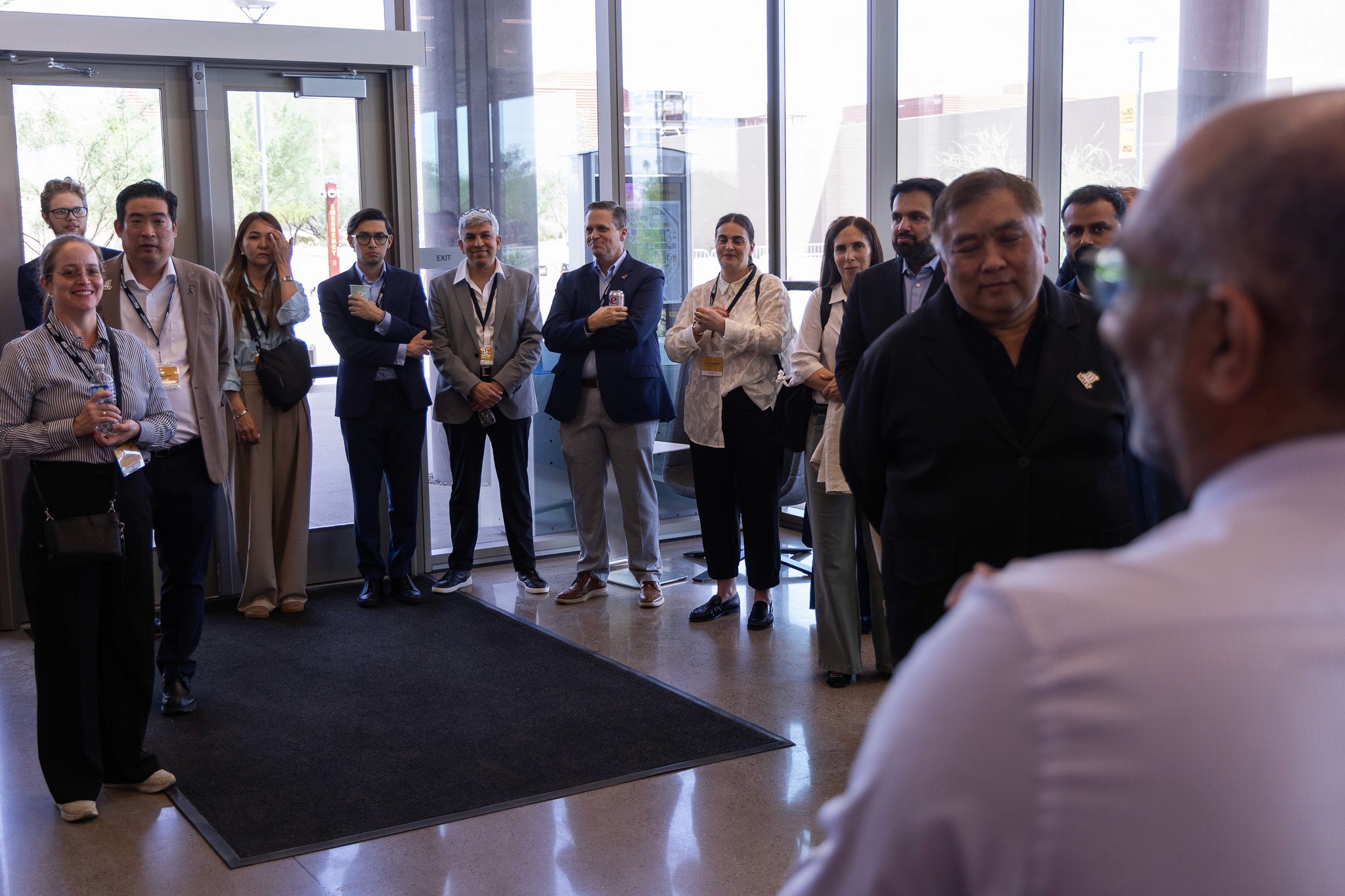
The network also enables collaborative research and knowledge exchange at scale. Faculty and researchers across participating institutions gain access to a broader set of collaborators, datasets, and regional insights. Problems that are inherently transnational — climate change, urbanization, public health, and artificial intelligence governance — benefit from precisely this type of distributed academic collaboration. The ASU-Cintana seed funding initiative is a good example of facilitating these types interdisciplinary teams that span geographies and institutional boundaries.
Equally important, the network creates institutional resilience. Higher education institutions increasingly face volatility in student mobility, regulatory environments, and local demographic trends. By participating in a global network, universities diversify their academic partnerships, student pathways, and innovation ecosystems. If one region experiences disruption — whether due to policy changes or economic cycles—the broader network provides alternative channels for collaboration, enrollment growth, and academic engagement. We are especially seeing these opportunities as the US implements more restrictive visa approvals.
This model also reduces risk while increasing the capacity for experimentation. Traditionally, universities bear the full cost and uncertainty of launching new programs, entering new markets, or implementing educational technologies. Within a network, institutions can pilot innovations collaboratively. Successful initiatives can then scale across multiple partners, while unsuccessful ones generate shared lessons rather than isolated institutional losses. The result is a more agile and adaptive system of higher education.
Perhaps most importantly, the ASU–Cintana network signals a shift from a model of institutional independence to coordinated global capability. Each university retains its governance, academic identity, and local mission. But through shared programs and strategic alignment, the network functions as something larger than the sum of its parts: a distributed global university system.
In an era when the scale of global challenges increasingly exceeds the capacity of individual institutions, networks like the ASU–Cintana Alliance may represent the next stage of higher education internationalization. The question is no longer simply how universities expand globally, but how they operate collectively to extend educational opportunity, accelerate innovation, and strengthen institutional resilience.
The power of the ASU–Cintana Alliance lies precisely in this shift—from isolated institutions to a coordinated global system capable of achieving what no single university could accomplish alone.
Relevant Stories

Alliance News
12 selected faculty members from different Health Sciences programs at Universum International College in Pristina, Kosovo, came together for a two-day Clinical Education Designer Level Workshop
Europe
·
8 min read

Milestone
At Galala University's third graduation ceremony, 25 students crossed the stage as the first graduates of the Galala University–Arizona State University dual-degree programs.
Middle East / North Africa
·
6 min read